try {
…
//code surveillé qui peut
générer des exceptions
}
catch(type1 id1) { // on peut avoir zero (à
condition qu'il y a "finally") ou plusieurs "catching" blocs
…
//traite les exceptions de type
type1 dans le bloc surveillé
}
catch(type2 id2) {
... //traite les
exceptions de type type2
}
…
finally { //on
peut avoir zero ou un "finally" blocs
…
//toujours executé, aucune
importance s'il y a eu lieu exception ou pas
}
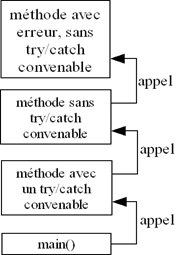
Call stack
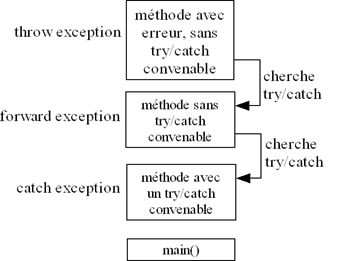
Recherche d'un try/catch bloc après
l'exception jeté
Exemple - La somme
de deux entiers introduits dans les champs texte exception non gérée:
import java.util.Scanner;
public class Sum {
public static void main(String[] arg) {
Scanner in = new
Scanner(System.in);
int first,second;
String rez;
System.out.println ("Addition of
two integers\n");
System.out.print("please input
the first integer: ");
first = getInt(in);
System.out.print("please input
the second integer: ");
second = getInt(in);
rez="\nthe sum of "+first+" and
"+second+" is: "+(first+second);
System.out.println(rez);
}
public static int getInt(Scanner in) {
return
Integer.parseInt(in.nextLine());
}
}
première version
exception gérée - programme termine l'exécution
import java.util.Scanner;
public class SumExc {
public static void main(String[] arg) {
Scanner in = new
Scanner(System.in);
int first=0,second=0;
String rez="";
System.out.println
("Addition of two integers\n");
try {
System.out.print("please input the first integer: ");
first = getInt(in);
System.out.print("please input the second integer: ");
second = getInt(in);
rez="\nthe sum of "+first+" and "+second+" is: "+(first+second);
}
catch(java.lang.NumberFormatException e1) {
rez="Both must be integers! The program terminated!";
}
finally {
System.out.println(rez);
}
}
public static int getInt(Scanner in)
{ //no catch here
return
Integer.parseInt(in.nextLine());
}
}
deuxième version - redemande
d'introduction, exception gérée dans la
méthode:
import java.util.Scanner;
public class SumExcIn {
public static void main(String[] arg) {
Scanner in = new
Scanner(System.in);
int first=0,second=0;
String rez="";
System.out.println ("Addition of
two integers\n");
System.out.print("please input
the first integer: ");
first =
getInt(in);
System.out.print("please input
the second integer: ");
second = getInt(in);
rez="\nthe sum of "+first+" and
"+second+" is: "+(first+second);
System.out.println(rez);
}
public static int getInt(Scanner in) {
boolean ok;
int rez=0;
do {
try {
rez = Integer.parseInt(in.nextLine());
}
catch
(NumberFormatException nfesc) {
ok=false;
System.out.print("not integer - input it again: ");
continue;
}
ok=true;
}while(!ok);
return rez;
}
}
troisième version - redemande
d'introduction, exception gérée
en dehors de la méthode:
import java.util.Scanner;
public class SumExcOut {
public static void main(String[] arg) {
Scanner in = new
Scanner(System.in);
int first=0,second=0;
boolean ok;
System.out.println ("Addition of
two integers\n");
do {
ok=true;
try {
System.out.print("please input the first integer: ");
first = getInt(in);
}
catch
(java.lang.NumberFormatException e1) {
ok=false;
System.out.print("Not integer! ");
}
}
while(!ok);
do {
ok=true;
try {
System.out.print("please input the second integer:
");
second = getInt(in);
}
catch
(java.lang.NumberFormatException e1) {
ok=false;
System.out.print("Not integer! ");
}
}
while(!ok);
System.out.println("The sum of
"+first+" and "+second+" is: "+(first+second));
}
public static int getInt(Scanner in)
{ //no try-catch here
return
Integer.parseInt(in.nextLine());
}
}
12.2.2
Instruction throw
if( q = = null)
throw new
NullPointerException();
12.2.3
Créer son propre type d'exception
Pour créer son propre type d'exception, il faut écrire
une classe héritant de la classe Exception ou une de ses classes
dérivées
Les exceptions sont gérées en dehors de la méthode
où elles se produisent:
import java.util.*;
public class Exc4 {
public static void main(String arg[]){
boolean ok;
Scanner sc = new
Scanner(System.in);
do{
ok = true;
try {
System.out.println("Note: "+Note(sc));
}
catch(InputMismatchException ex1) {
System.out.println ("the note must be integer - try
again");
sc.nextLine();
ok=false;
}
catch (NoNote
ex2) {
ok=false;
}
}while(!ok);
}
static int Note(Scanner sc) throws
NoNote{ //checked exception
int note;
System.out.print("next note:");
note = sc.nextInt();
if((note>6)||(note <2)){
throw new
NoNote("outside [2,6] - try again");
}
return note;
}
}
12.2.4
Catégories des exceptions
On peut diviser les exceptions en deux catégories - "unchecked"
et "checked". Les premières sont des exceptions dont la classe
de base est "RuntimeException" (dérivée de "Exception").
Il n'est pas obligatoire de gérer ces exceptions.
Exemple - division à zéro sans traiter l'exception
ArithmeticException (elle est "unchecked").
public class Exc1 { public static void
main(String arg[]){
System.out.println("rez:"+func(5,0)); } static int
func(int a, int b){
return a/b; } }
L'exception est traitée
public class Exc2 { public static void
main(String arg[]){
try{
System.out.println("rez:"+func(5,0));
}
catch(ArithmeticException ex){
System.out.println("divide by zero");
} } static int
func(int a, int b){ return a/b; } }
Par contre le
compilateur refusera systématiquement de compiler une
méthode capable de provoquer une "checked" exception, si cette
exception n'est pas rattrapée (par
try/catch ) ou tout du moins signalée comme susceptible de
générer ce type d'exceptions (par le mot clé
throws).
static int Note() throws NoNote{ Scanner sc = new
Scanner(System.in); int note;
System.out.print("next note:"); note =
sc.nextInt(); if((note>6)||(note
<2))
throw new
NoNote("outside [2,6]"); return note; }